School Bus Overturns in Georgia - Many Students Hurt
J&J, Novartis Recall Fentanyl Pain Patches Over Possible Leak
Cell Phone Use in Car Leads to $5.2 Million Payout by Employer
Government Lists Worst Nursing Homes
Consumer Awarded Damages from Credit Reporting Agency
Ohio Supreme Court Ruling Eliminates Jury Discretion
Arbitration a growing trend in health care
$38.5 million to Compensate Boy Born Stricken by Cerebral Palsy
Lawsuit: tumorous lungs put in lung recipient patient
With the increased number of Sport Utility Vehicles (SUVs) on the road, Georgia has seen a steady increase in the number of “rollover” accidents. While rollovers are still relatively rare, they are much more likely to cause serious injury or death when they do occur. Rollovers currently account for about one of every forty reported crashes, but they account for one of every three fatalities on the road.
According to the National Highway Transportation Safety Administration (NHTSA), the vast majority of rollovers actually occur under ordinary driving conditions. Wind, rain, and snow do not necessarily make rollovers more likely. Instead, rollovers occur when drivers suddenly swerve to avoid obstacles in the road or when drivers accidentally veer off the road. When this occurs, the off-balance vehicle and the high center of gravity combine to flip the car over.
Since 2004, the NHTSA has given all vehicles a “rollover rating” based on the vehicle’s Static Stability Factor. The Static Stability Factor is a geometric calculation that divides the track width (distance between the right and left tires) by the center of gravity. Rollover and crash test ratings can be found here.
Alcohol use and speed are also contributing factors to vehicle rollovers.
In order to reduce your risk for having a rollover, the AAA Foundation for Traffic Safety offers these tips:
Don’t Drive Too Fast. By sticking to the posted speed limit you give yourself more time to react to any obstacles in the road. Additionally, even if you are surprised by an emergency and have to swerve, the lower rate of speed will keep your vehicle on all four wheels.
Avoid Overcorrecting Your Steering. Studies show that many rollovers occur when drivers have swerved and are overcorrecting their steering.
Practice Extra Care on Rural Roads. Back roads, particularly those that are undivided or don’t have barriers pose an added risk when the vehicle leaves the pavement. These roads are more likely to have a drop between the level of the pavement and the level of the grass or dirt on the side of the road. This drop can present an added risk of rollover by shifting the car’s balance.
Properly Inflate Tires. Improperly inflated and worn out tires can be especially dangerous because they affect your ability to control the vehicle. Worn tires are also dangerous because of their propensity to let the vehicle slide on wet pavement.
Avoid Overloading the Vehicle. To find out the maximum safe load for your vehicle, consult your owner’s manual. Overloading the vehicle, especially with a roof rack, can have a substantial impact on the vehicle’s center of gravity.

Jason R. Schultz
34 Peachtree Street N.W.
Suite 2570
Atlanta, GA 30303
Phone: (404) 474-0804
Fax: (404) 577-0564

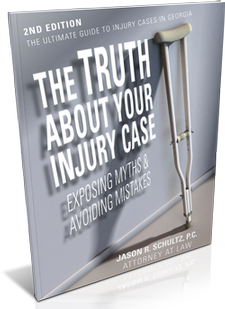
The Truth about your Injury Case
Debunking Myths and Avoiding Mistakes.
To request this book, please contact us today.
Under what circumstances can I sue for medical malpractice?...
What needs to be proven in my medical malpractice case?...
How do I handle the property damage to my car?...
Do I have to get the car repaired where the insurance company tells me to get it repaired?...
Will the other person's insurance company get an estimate of their own?...
Do I have to get three estimates?...
What if my estimate and the insurance company's estimate do not match?...
What happens if one trips on a brick near a construction site while on a public sidewalk?...
How is an automobile accident case different from a tractor trailer accident case?...
How much insurance are trucks required to carry by federal and/or state law?...
$160,500 - Sponge left in abdomen by surgeon
$1,047,000 - Hospital negligently released patient
$105,000 - Tweed v. Moriles. State Court of Clayton, Jonesboro, Georgia
$275,000 - Ray v. Smiley. State Court of Forsyth County, Cumming, Georgia
$100,000 - Johnsen v. Smithson. State Court of Fulton County, Atlanta, Georgia
$40,000 - Price v. Sellers. Superior Court of Carroll County, Carrollton, Georgia
$100,000 - Silver v. Upton. State Court of Fulton County, Atlanta, Georgia
$325,000 - Broadnax v. Autozone, Inc., Fulton Superior Court, Atlanta, Georgia
$65,000 - Hector v. Sears Roebuck and Co. State Court of Fulton County, Atlanta, Georgia
$75,000 - Davis v. AATC and Kone, Inc. State Court of Clayton County, Jonesboro, Georgia
$30,000 - D’Hollosy v. Rich’s Department Stores, Superior Court of Fulton County, Atlanta, Georgia
$933,100 - Wilson v. Sanifill, Inc. State Court of Fulton County, Atlanta, Georgia
$562,000 - Banks v. Canal Insurance Company, et. al. State Court of Fulton County, Atlanta, Georgia